

Hey there! As a supplier of R290 condensing units, I often get asked about the type of expansion valve used in these units. So, I thought I'd write this blog to share some insights on this topic.
First off, let's understand what an expansion valve does in a refrigeration system. The expansion valve is a crucial component that controls the flow of refrigerant into the evaporator. It reduces the pressure of the refrigerant from the high-pressure side (condenser) to the low-pressure side (evaporator), allowing the refrigerant to expand and absorb heat from the surrounding environment.
Now, when it comes to R290 condensing units, there are a few types of expansion valves that are commonly used.
Thermostatic Expansion Valve (TXV)
One of the most popular choices is the thermostatic expansion valve. A TXV is designed to maintain a constant superheat at the outlet of the evaporator. Superheat is the difference between the actual temperature of the refrigerant vapor and its saturation temperature at a given pressure.
Here's how it works. The TXV has a sensing bulb that is attached to the outlet of the evaporator. This bulb contains a refrigerant that expands or contracts based on the temperature of the refrigerant vapor leaving the evaporator. As the temperature changes, the pressure inside the sensing bulb also changes. This pressure change is transmitted to a diaphragm inside the valve, which then adjusts the opening of the valve to regulate the flow of refrigerant.
The advantage of using a TXV in an R290 condensing unit is that it can provide precise control of the refrigerant flow, which helps to optimize the performance of the refrigeration system. It can adapt to changes in load and operating conditions, ensuring that the evaporator operates efficiently.
Electronic Expansion Valve (EEV)
Another option is the electronic expansion valve. An EEV uses an electronic controller to regulate the flow of refrigerant. It can be more accurate and responsive than a TXV, especially in systems that require precise temperature control.
The EEV is controlled by a microprocessor that receives input from various sensors, such as temperature sensors and pressure sensors. Based on this input, the controller adjusts the opening of the valve to maintain the desired superheat or other operating parameters.

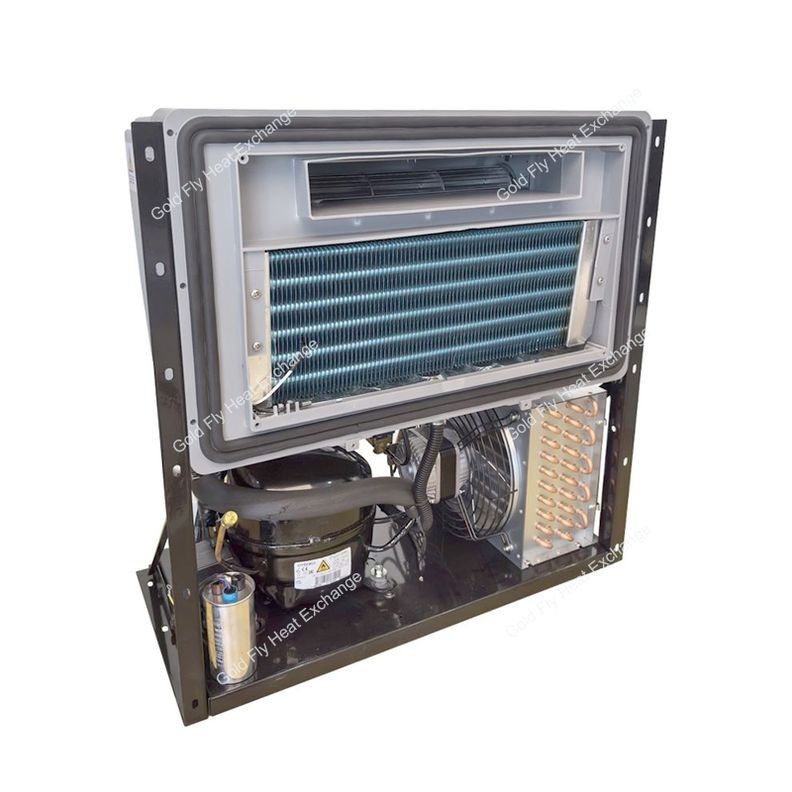
One of the benefits of an EEV in an R290 condensing unit is its ability to provide better energy efficiency. It can adjust the refrigerant flow more quickly and accurately than a mechanical valve, which can help to reduce energy consumption. Additionally, an EEV can be integrated with other control systems, allowing for more advanced monitoring and control of the refrigeration system.
Capillary Tube
A capillary tube is a simple and inexpensive type of expansion device. It is a small-diameter tube that restricts the flow of refrigerant based on its length and diameter.
In an R290 condensing unit, a capillary tube can be used as a fixed-orifice expansion device. The refrigerant flows through the capillary tube, and the pressure drop across the tube causes the refrigerant to expand. The length and diameter of the capillary tube are selected based on the specific requirements of the refrigeration system.
The advantage of using a capillary tube is its simplicity and low cost. It has no moving parts, which means there is less maintenance required. However, it has some limitations. It is not as flexible as a TXV or EEV and cannot adapt to changes in load or operating conditions as easily.
So, which type of expansion valve is the best for an R290 condensing unit? Well, it depends on several factors, such as the application, the size of the system, and the required level of control.
For small to medium-sized R290 condensing units used in applications like Refrigerator and Chiller, a capillary tube or a TXV may be sufficient. These valves are relatively simple and cost-effective, and they can provide adequate performance for these types of applications.
On the other hand, for larger R290 condensing units or applications that require precise temperature control, such as in commercial refrigeration or industrial cooling, an EEV may be a better choice. It can offer more accurate control and better energy efficiency, which can result in long-term cost savings.
If you're considering a Monoblock Refrigeration Unit using R290 refrigerant, it's important to work with a knowledgeable supplier who can help you select the right expansion valve for your specific needs. At our company, we have extensive experience in providing R290 condensing units and can offer expert advice on the best expansion valve options for your application.
We understand that every customer has unique requirements, and we're committed to providing customized solutions that meet your needs. Whether you need a small unit for a residential refrigerator or a large system for a commercial cold storage facility, we can help you find the right R290 condensing unit with the appropriate expansion valve.
If you're interested in learning more about our R290 condensing units or have any questions about the expansion valves we use, please don't hesitate to get in touch. We'd be happy to discuss your requirements and provide you with a detailed quote. Let's work together to find the perfect refrigeration solution for your business!
References
- ASHRAE Handbook - Refrigeration. American Society of Heating, Refrigerating and Air-Conditioning Engineers.
- "Refrigeration and Air Conditioning Technology" by William C. Whitman, William M. Johnson, and John Tomczyk.